
Not Everything Needs To Be Made
Fashion, sustainability, and participation without output

This piece picks up where my last post, Opting In By Default, left off. If that one was about structure and stability, this is about what happens when you start questioning what you’re actually participating in.
I want to contribute something that moves culture forward—not just something that looks good.
That impulse has followed me for years, especially as my interest in fashion, photography, and writing has ebbed and flowed, tangled together, and deepened. But it’s always been paired with hesitation. Fashion, in particular, becomes difficult to engage with honestly once you spend any real time understanding how it functions. The waste, the extraction, and the inefficiency aren’t side effects—they’re structural. Even at its best—ethical, transparent, and sustainably sourced—it’s still new production. It still asks the world for more, just with better marketing attached.
Coming from a scientific background makes that tension hard to ignore. Science trains you to think in systems, to look for externalities, and to ask where things come from, where they go, and who absorbs the cost. You’re taught to be suspicious of clean narratives and elegant solutions. Fashion, by contrast, often survives by keeping those questions comfortably out of frame—or by answering them just convincingly enough to move on.
The result is a kind of paralysis. I’m drawn to fashion not just as an aesthetic pursuit, but as a cultural one. It’s a language, a signal system, and a way people situate themselves in the world. But it’s hard to reconcile that interest with the reality that the industry already produces far more than it knows how to metabolize. Even when production is done “right,” the underlying logic doesn’t really change. Sustainability softens the edges, but it doesn’t undo consumption. More often, it just makes continuation feel defensible.
At the same time, refusing to participate entirely feels like its own dead end. Cultural stagnation isn’t neutral either. So you end up caught between two unsatisfying positions: make things and feel complicit, or make nothing and feel irrelevant. Neither option feels particularly honest.
This tension mirrors something broader in my life. I’m technically trained and work in a highly regulated, procedural field. Almost everything I do follows strict guidelines, standard operating procedures, and layers of review. There’s very little room for interpretation, let alone creativity. After spending all day working by the book, activating the creative part of my brain doesn’t usually feel restorative—it feels effortful. The mental mode doesn’t switch easily.
Then there’s the guilt. If I spend my free time improving technical skills—refining data workflows, building dashboards, or re-learning an equation I’ve long forgotten—I feel like I’m neglecting the creative side of myself. If I spend time writing, photographing, or thinking about clothes, I feel irresponsible for not sharpening my professional edge. Add fitness, reading, cooking, and the simple desire to enjoy something without justifying it, and suddenly every hour feels like a referendum on productivity.
I’m not bad at resting. I’m bad at letting myself enjoy rest.
This collapses into a vague dissatisfaction with how I’m spending my time, both personally and professionally. I don’t think this is unique to me. A lot of people my age feel it—especially those who were trained for narrow expertise in a world that no longer resembles what we were promised in our youth. But knowing you’re not alone doesn’t make the answers any easier to find.
What I keep returning to is the idea that cultural contribution doesn’t have to mean producing new objects. Fashion isn’t only garments. It’s context, preservation, reinterpretation, taste-making, writing, repair, reuse, documentation, and so much more. The recent surge of interest in vintage clothing feels like one of the few areas where the broader space has actually gotten something right—not because it’s perfect, but because it acknowledges that value doesn’t always require novelty. There are ways to engage that don’t demand adding more volume to an already saturated system.
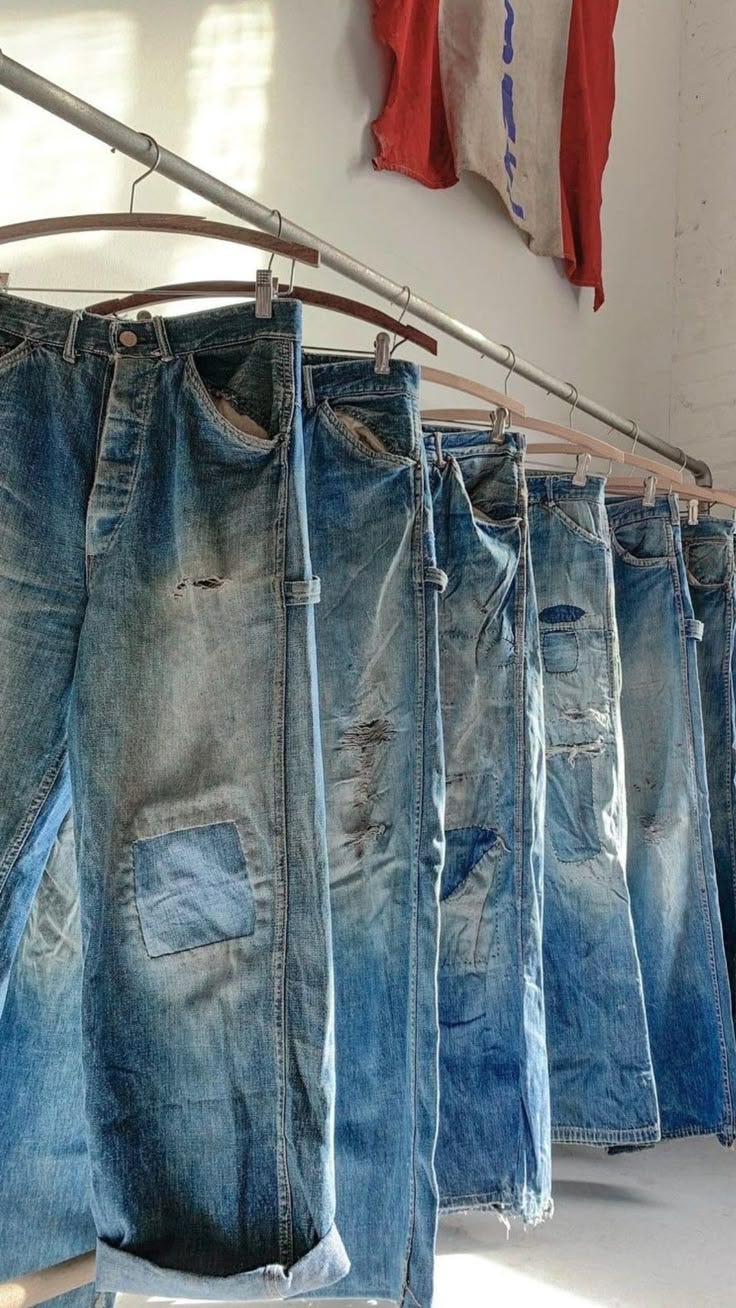
This is where I start to feel most alienated from Instagram-era fashion culture. Somewhere along the way, caring about clothes became synonymous with eventually launching something. A micro-label. A capsule. A “small run” that somehow still needs to justify itself through growth. Liking clothes long enough now seems to obligate you to manufacture more of them, preferably with a compelling origin story and a Shopify backend.
In that ecosystem, restraint reads as a lack of ambition. Thoughtfulness gets reframed as hesitation. The highest form of participation is production, and the fastest way to signal seriousness is to put your name on a hangtag. The result is a steady churn of micro-labels that differ mostly in typography, each one framed as a corrective to the last, all quietly contributing to the same excess they claim to critique.
Not every fashion influencer or vintage reseller needs to start a brand. In fact, the vast majority of them simply shouldn’t. I understand the need to make a living, but liking clothes does not obligate you to add more clothes to the world. The current culture makes it strangely difficult to say that out loud, because it disrupts the idea that progress must always be visible, scalable, and most importantly, for sale.
Maybe that’s where my skill set actually fits. Coming from science, I’m comfortable with ambiguity, iteration, and slow accumulation. I’m less interested in definitive solutions than in asking better questions. What does sustainability look like beyond materials and supply chains? How do you slow culture down without freezing it? How do you participate without pretending purity is possible?
I don’t have clean answers. I’m suspicious of anyone who does. But these are questions I hope to explore further in this space. What I am increasingly convinced of is that the pressure—to monetize every interest, to optimize every effort, and to resolve every contradiction—tends to erode the most interesting work.
What feels more honest, at least for me, is resisting the idea that contribution has to look like production. I don’t know if there’s an end state where everything coheres neatly. What I’m aiming for instead is a way of existing that’s attentive, critical, and alive—aware of the systems I operate within, even when I can’t fully escape them.